Dr.Elchin Gaziyev


Want to get braces but not sure which type is right for you? In this article, we’ll provide detailed information about the most commonly used types of metal braces. This way, you’ll be able to make the right choice based on your needs and aesthetic expectations.

Types of Braces and Their Features
Metal Braces
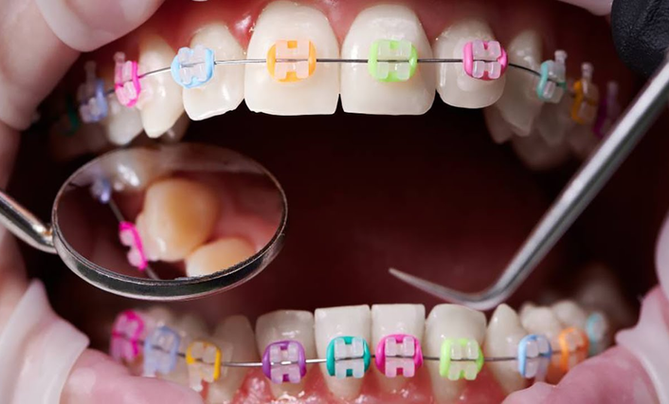
Traditional braces typically consist of metal brackets and wires. This system is fixed to the teeth and allows for gradual movement in the desired direction.
In recent years, heat-activated archwires have been introduced as a new technology added to traditional systems. These wires respond to body heat in the mouth, helping teeth move faster and with less discomfort. This type of braces is usually the most affordable and highly effective, making it one of the most widely used orthodontic systems today.
Although traditional metal braces stand out for their functionality and effectiveness among all types of braces, they are more noticeable in appearance. To improve aesthetics, colored elastic bands can be used, though they still remain a visible option.
Ceramic Braces
Ceramic braces are similar in shape and size to traditional metal braces. However, the main difference is that they are made from ceramic material and blend with the tooth color, making them less noticeable in the mouth.
Advantages:
-
Less visible, more aesthetic
-
As effective as metal braces
Disadvantages:
-
More expensive than traditional braces
-
Can stain if not properly cleaned
Lingual Braces
Lingual braces are also made of metal, but they are attached to the inner surface of the teeth. As a result, they are not visible from the outside and are preferred for their aesthetic advantage.
Advantages:
-
Hidden from view (invisible braces)
-
More comfortable in social situations
Disadvantages:
-
Takes longer to align teeth
-
May cause discomfort and speech difficulty
-
Harder to clean
Clear Aligners (Invisalign)
The Invisalign system is one of the most distinct types of orthodontic treatment. Instead of brackets and wires, it uses custom-made, clear plastic aligners. These aligners are changed every two weeks and worn continuously during the treatment.
Advantages:
-
Virtually invisible
-
Removable during meals and drinks
-
Less irritation and discomfort
Disadvantages:
-
Suitable only for mild to moderate cases
-
Among the most expensive options
-
Only appropriate for teens and adults
Self-Ligating Braces
This type of braces is similar in shape to traditional ones but uses clips instead of elastic bands. This allows the wires to move with less friction and makes cleaning easier.
Advantages:
-
Reduced friction
-
Easier to clean and maintain
Treatment of Dental Misalignment in Children with Different Types of Braces
Orthodontic Treatment of Dental Misalignment in Children Using Braces
A correct dental alignment is important not only for aesthetic reasons but also for overall oral health. When parents notice crooked teeth or bite problems in their children, they often wonder: "Does my child need braces, and which type is best?" Not all children require braces, but timely orthodontic evaluation can answer these questions. A professional check-up helps determine whether treatment is necessary and which type of braces is most suitable.
Because children's dental and jaw development changes at various stages, the timing of examination and intervention is critical. Orthodontists typically evaluate children at the following age stages:
Key ages for orthodontic check-ups:
-
Age 4: This is when the primary (baby) teeth are complete. Initial jaw and dental development are examined. Risk factors such as thumb sucking and early tooth loss are assessed.
-
Age 8: Early permanent dentition begins. Baby teeth gradually give way to permanent ones. Jaw symmetry and tooth alignment are observed.
-
Age 12: Late permanent dentition stage. Jaw structure is fully developed, and if intervention is necessary, this is the ideal period for assessment.
Ideal age for starting treatment:
-
Ages 7–12: Considered the best time. Since the jaw and teeth are still developing, the body responds naturally to treatment.
-
Ages 5–6: Recommended only in special or severe cases (e.g., jaw disorders or major asymmetry).
There are two main types of braces used for children: removable and fixed braces. Removable braces are typically used to guide jaw development and correct mild misalignments. They are custom-made and should be worn for around 15 hours daily. Their effectiveness depends on consistent use. Parents should support their child's motivation and maintain proper hygiene. These braces should be removed during meals and stored in a special container afterward.
For more complex cases, fixed braces are used. In this system, brackets are glued to the teeth and connected by elastic or heat-activated wires. Since fixed braces work continuously, they are not dependent on the child’s discipline and typically yield faster results. Treatment usually lasts 2–3 years. While some children may feel self-conscious about wearing metal braces, modern orthodontics offers alternatives such as clear ceramic braces and invisible lingual systems.
After the braces are removed, maintaining the result is crucial. There's a risk of teeth shifting back. To prevent this, retainers are used. There are two types: a fixed retainer — a thin wire bonded to the back of the teeth, and a removable retainer — a clear tray worn at night. Both help maintain the results of treatment.
Many orthodontic problems in children are acquired rather than genetic. Poor habits or early loss of baby teeth often lead to misalignments. For example, prolonged thumb sucking may push upper teeth forward and cause an open bite. Early loss of baby teeth may leave insufficient space for permanent teeth. To prevent such issues, parents should:
-
Address thumb-sucking early (wean off pacifiers after age 3)
-
Maintain proper oral hygiene and ensure a healthy diet to protect baby teeth
-
Monitor habits and seek timely orthodontic advice
In conclusion, braces for children are not just for a perfect smile but for lifelong oral health. When choosing the type of braces, the orthodontist’s recommendation and the child's individual needs must be considered. At RealDent Clinic, children receive professional care with both removable and fixed braces and a personalized treatment plan. Taking the right step at the right time ensures both health and self-confidence for your child.

Dental printer
Types of Braces and Technology
Types of Braces and Technology
Traditionally, when people thought of orthodontic treatment, they imagined a mouth full of metal wires and years of discomfort. However, with the advancement of technology, this field has completely evolved. Modern orthodontics is now more precise, less invasive, and significantly more comfortable for patients.
One of the most significant innovations is the digital intraoral scanner and 3D imaging technology. In the past, physical molds were used to take impressions of the mouth. Now, with intraoral scanners, the mouth is captured digitally with high accuracy and in real time. This allows orthodontists to plan treatments with greater precision and tailor solutions to each patient.
Modern Types of Braces and Technologies:
-
Self-ligating braces: These use clips instead of elastic bands, reducing friction and allowing teeth to move more efficiently and comfortably.
-
Clear aligners: Removable, transparent trays made using 3D technology that gradually move teeth without the need for wires or brackets. They offer a discreet and aesthetic solution.
-
Laser technology: Used in soft tissue procedures such as reshaping gums. This method offers less pain and faster recovery.
-
CAD/CAM technology: Enables the design of braces and aligners with computer precision, improving treatment outcomes.
-
3D printing: Allows the rapid and accurate production of orthodontic devices such as retainers and braces.
-
Treatment simulation software: Provides a visual preview of the expected results, so patients can see their future smile before starting treatment.
Thanks to these innovations, types of braces are now more personalized, effective, and aesthetic. At the same time, brace prices vary depending on the chosen system and technology. A consultation with your orthodontist is the best way to determine the most suitable option for your needs.